
What is volleyball?
Volleyball is a team sport in which two teams of six players face each other across a high net. The aim is to send the ball over the net so that it lands on the opponents' court – or so that they cannot return it.
Every rally begins with a serve. The receiving team may touch the ball up to three times to control it, set it up and attack it back over the net. A point is scored on every rally, either when the ball lands on the opponents' court or when a team commits a fault.
Players rotate clockwise around the court during the match, so everyone plays both at the net and in the back row. Many teams also use a specialist defensive player called the libero, who wears a different coloured shirt. Let's go through the rules step by step.
The volleyball court and net
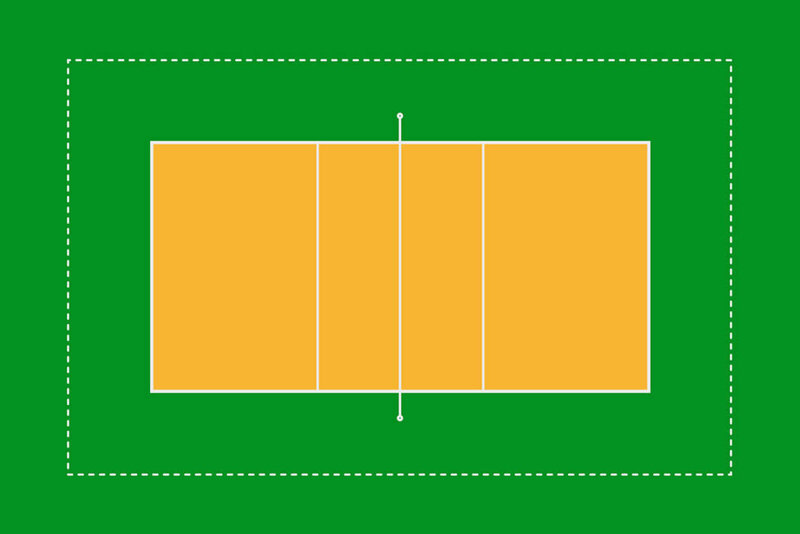
- Court size: 18 m long and 9 m wide, split into two 9 × 9 m halves by the centre line under the net.
- Free zone: an area of at least 3 m around the court where players may run to play the ball. In top-level international competitions it is 5 m at the sides and 6.5 m behind the end lines. The ball landing in the free zone is out.
- Net height: 2.43 m for men and 2.24 m for women. Lower nets are used in youth volleyball.
- Antennae: two flexible rods on the net, directly above the sidelines. The ball must cross the net between them.
- Lines: the lines are part of the court, so a ball touching the line is in.
The attack line and back-row players
On each side of the net there is a line 3 m from the centre line, called the attack line. It splits each half into a front zone and a back zone.
The three back-row players may not complete an attack from inside the front zone when the ball is entirely above the height of the net. A back-row player can still attack by taking off from behind the attack line and landing in front of it – the classic back-row attack. The same player may also set or pass the ball in the front zone, as long as it is not an attack hit above the net.
The rule keeps the team's best hitter from attacking at the net all the time, which makes the game more varied and forces the whole team to work together.
The ball, kit and team captain
The ball
A regulation indoor ball is spherical, made of leather or synthetic leather, 65–67 cm in circumference and 260–280 g in weight.
Kit and shirt numbers
- Players in a team wear the same colours, and the libero wears a shirt in a clearly different colour.
- Numbers must be easy to see: at least 15 cm high on the chest and 20 cm on the back, with a stroke at least 2 cm wide.
- The team captain's number is underlined with a stripe.
- Shoes must be light and flexible, with rubber or composite soles and no heels. The first referee can allow a player to change wet or damaged kit.
Team captain
The captain signs the score sheet before the match and represents the team at the coin toss. When the captain is on court they act as the game captain; when they are off court, the coach or captain appoints another player (not the libero). Only the game captain may speak to the referees during the match, and only when the ball is out of play.
Coin toss
Before the match the referee tosses a coin with the two captains. The winner chooses either to serve or receive first, or which side of the court to start on. The loser gets the remaining choice.
Team line-up and positions
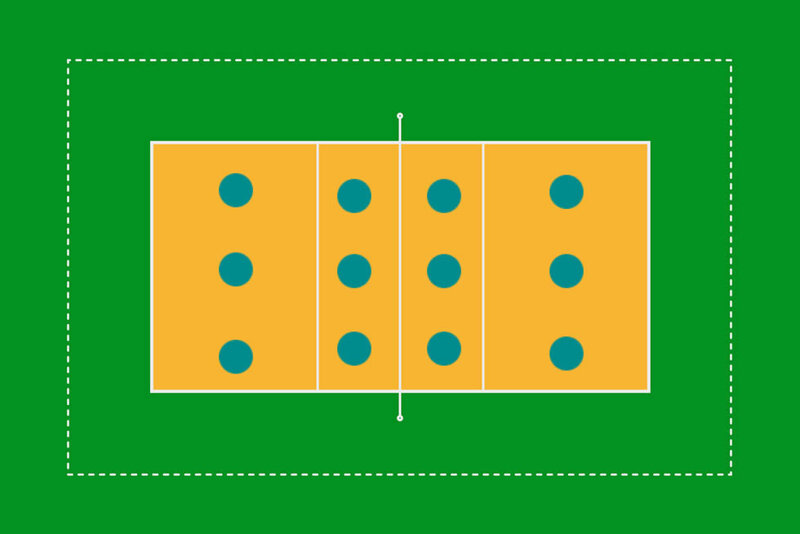
Each team always has six players on court. Before each set the coach hands in a line-up sheet showing the starting rotation. The order cannot be changed during the set, except through legal substitutions and libero replacements. If a team is found to have played out of order, it loses the points scored in the wrong rotation, and the opponents get a point and the serve.
The six players are split into three front-row players (positions 4, 3 and 2 from left to right) and three back-row players (positions 5, 6 and 1). Position 1, at the back right, is the server. Many coaches plan the starting rotation for each set in a line-up builder, so the whole team knows where they start.
Illustration: position 1 (back right) serves. When a team wins the serve back, every player moves one position clockwise – the player in position 2 moves to position 1 and serves.
Positional faults
At the moment the ball is served, each player must be in the right order relative to their neighbours: each back-row player must be behind their front-row partner, and players in the same row must be in the correct order from left to right. As soon as the ball has been served, players may move anywhere on their own court.
If a team is out of position when the ball is served, it is a positional fault: the opponents win the point and the serve.
Rotation
Each time a team wins the right to serve from the opponents, its players rotate one position clockwise: the player in position 2 moves to position 1 and serves. Serving out of rotation gives the opponents a point and the serve.
Serving
- The server has 8 seconds after the first referee's whistle to serve.
- The ball is served from behind the end line, anywhere across the width of the court, and must be hit with one hand or arm after being tossed or released.
- A serve that touches the net but still crosses into the opponents' court is in play.
- Team-mates may not block the receivers' view of the server or the ball's path by screening – for example by waving arms or standing close together in a group.
A serve that lands out, hits the net and stays on the serving side, or passes outside the antennae is a service fault, and the point goes to the receiving team.
Playing the ball
When is the ball in play?
The rally starts when the ball is hit for the serve after the referee's whistle, and ends at the next whistle for a fault or a ball that lands.
When is the ball out?
- It lands completely outside the boundary lines.
- It touches an object outside the court, the ceiling or a person who is not playing.
- It touches the antennae, the posts, the ropes or the net outside the antennae.
- It crosses the net completely or partly outside the crossing space between the antennae, or passes under the net.
Three touches
- A team may touch the ball up to three times before sending it over the net. A touch by a blocker does not count as one of them.
- The ball may touch any part of the body – hands, forearms, head, even a foot.
- The same player may not touch the ball twice in a row (except after a block).
- If two team-mates touch the ball at the same time, it counts as two touches.
- On the team's first touch, the ball may touch several parts of the body in a row, as long as it happens in one action – for example a dig that hits the forearms and then the chest.
Touch faults
- Catch: the ball must be hit, not caught or thrown.
- Four hits: touching the ball four times before returning it.
- Double contact: the same player touching the ball twice in a row, or the ball touching different parts of their body one after another (outside the first-touch exception).
A ball that touches the net during a rally is still in play, as long as the team has touches left.
At the net: crossing and touching
- Players may reach over the net on their follow-through after an attack, as long as they touched the ball on their own side.
- Under the net, a player may enter the opponents' court with a foot as long as part of the foot stays on or above the centre line. Any other part of the body above the feet may touch the opponents' court if it does not interfere with their play.
- Players may enter the opponents' free zone, provided they do not interfere with the opponents' play.
- Touching the net between the antennae while playing the ball is a fault. If the ball is driven into the net so hard that the net touches an opponent, it is not a fault.
- Players may touch the posts, ropes or any object outside the antennae, as long as it does not affect play.
- It is a fault to touch the ball or an opponent in the opponents' space before or during their attack.
Blocking
A block is when players close to the net reach above it to stop an attack from the opponents. Only front-row players may complete a block.
- Blockers may reach over the net, as long as they do not touch the ball before or during the opponents' attack hit.
- Several blockers may touch the ball in one action, and a block can include consecutive touches by the same player.
- The block touch does not count as one of the team's three touches, so after a block the team still has three touches.
- It is not allowed to block the opponents' serve.
Scoring and winning a match
Volleyball uses rally-point scoring: every rally gives one point to someone. A team wins a point when the ball lands on the opponents' court, when the opponents commit a fault, or when the opponents receive a penalty.
- A set is won by the first team to reach 25 points with a lead of at least two points. At 24–24 play continues until one team is two points ahead (26–24, 27–25 and so on).
- A match is usually played as best of five sets: the first team to win three sets wins.
- If the sets are level at 2–2, a deciding fifth set is played to 15 points, again with a two-point lead.
Tip for clubs: many volleyball clubs use SportMember for match statistics and online payments – and it is free to get started.
The libero
The libero is a specialist back-row defender, often one of the quickest players in the team and rarely the tallest. A team may register up to two liberos, but only one can be on court at a time.
- The libero may only play in the back row.
- The libero may not serve, block or try to block, and may not attack the ball when it is entirely above the height of the net.
- If the libero sets the ball with fingers (an overhead pass) from inside the front zone, team-mates may not attack that ball above the height of the net.
- Libero replacements do not count as substitutions and are unlimited, but there must be a completed rally between two replacements. They take place on the replacement zone by the team's bench.
- The libero can only be replaced by the player they came on for, or by the team's second libero.
- If a libero is injured or declared unable to play, the team uses its second libero. A team with only one libero may re-designate a new libero from the players not on court.
Timeouts, substitutions and breaks
- Timeouts: each team may take two 30-second timeouts per set. The coach, or the game captain if there is no coach, requests them when the ball is out of play.
- Technical timeouts: these are no longer part of the standard rules. Some international competitions still use their own, so check your league's regulations.
- Substitutions: each team may make six substitutions per set. A starting player may be substituted once and may then return, but only to their original position in the line-up. Several players can be substituted at the same time.
- Breaks between sets: three minutes. The organiser may extend the break between the second and third sets to up to 10 minutes.
Exceptional substitution for injury
If an injured player cannot continue and a legal substitution is not possible, the team may make an exceptional substitution with any player not on court at that time (not the libero or the player they replaced). It does not count towards the six substitutions, and the injured player may not return in that match.
Misconduct and sanctions
Referees deal with poor behaviour in steps. Minor misconduct first gets a verbal or yellow-card warning, which does not cost a point. More serious or repeated misconduct is penalised:
What changed in the 2025–2028 rules?
FIVB Official Volleyball Rules 2025–2028
The current rulebook runs from 2025 to 2028. Most of the game is unchanged, but these points are new or clarified:
- Screening: players may not use coordinated movements to hide the serve from the receiving team.
- Ball crossing outside the antennae: a team's second or third hit that crosses into the opponents' free zone outside the antennae is out once it crosses the plane of the net.
- Video challenges: in competitions with video challenge, a challenge is now made after the rally has finished.
- Trial rules: FIVB is testing a free position for the serving team at the moment of the serve, and more tolerance for double contact on the set. These only apply in the competitions testing them.
Quick answers
How many players are on a volleyball team?
Each team has six players on court: three in the front row and three in the back row. Teams can also have substitutes and up to two liberos.
How many touches does a team get in volleyball?
A team may touch the ball up to three times before it must go over the net. A block touch does not count, and the same player may not touch the ball twice in a row.
How many points is a volleyball set?
A set is played to 25 points with a two-point lead. The deciding fifth set is played to 15 points, also with a two-point lead.
What does the libero do in volleyball?
The libero is a specialist back-row defender in a different coloured shirt. The libero may not serve, block or attack the ball above net height, and replacements for the libero are unlimited.
Can you touch the net in volleyball?
No. Touching the net between the antennae while playing the ball is a fault. Touching the net outside the antennae, or being pushed into it by the ball, is not a fault if it does not affect play.