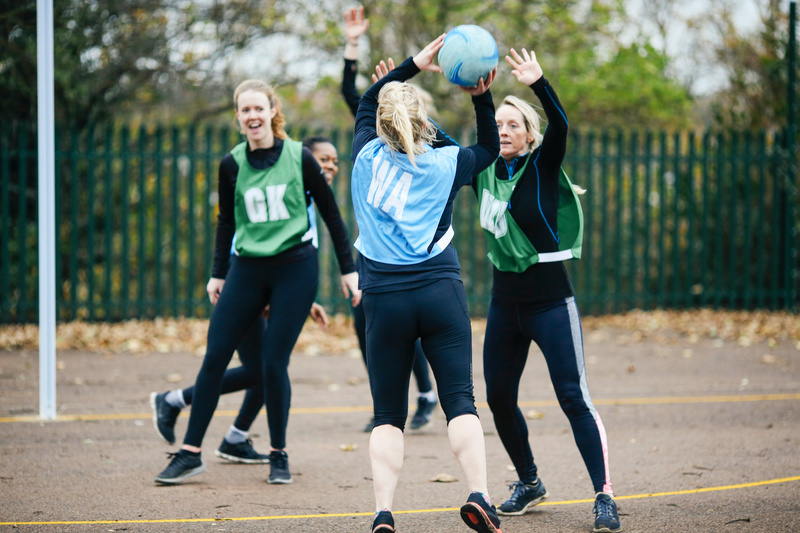
What is netball?
Netball is a fast team sport played between two teams of seven players. The aim is simple: score more goals than the other team by throwing the ball through a ring mounted on a 3.05 m (10 ft) post. There is no backboard, no dribbling and no running with the ball, so the game is built on quick, accurate passing, clever movement into space and tight defending.
Every player has a position with its own area of the court, which makes netball easy to learn and very tactical once you get into it. It is played by millions of people worldwide, from school PE lessons and back-to-netball sessions to professional leagues such as the Netball Super League in the UK.
If you are new to the game, the rules can look like a lot at first. Once you understand the court, the positions and a handful of core rules on footwork, contact and obstruction, everything else falls into place. That is exactly what this guide covers.
A brief history of netball
Netball grew out of early basketball. It was introduced in England in the 1890s, where it was first known as "women's basketball" and played mainly in schools and colleges. The rules were adapted for outdoor courts and long skirts, which is one reason the game developed its own identity: no dribbling, fixed playing areas and a ring without a backboard.
The sport spread quickly through the Commonwealth. The first international test match was played in 1938 between Australia and New Zealand, and the international federation – today known as World Netball – was founded in 1960 to create one common set of rules. Netball has been part of the Commonwealth Games since 1998, and the Netball World Cup is held every four years.
The netball court and equipment
Netball can be played indoors or outdoors on a hard, flat court. That makes it a sport you can play all year round, and many clubs switch between outdoor courts in summer and sports halls in winter.
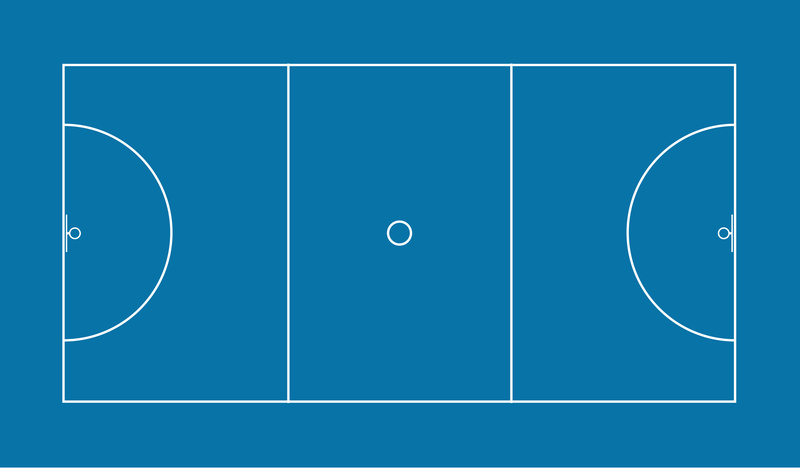
- Size: the court is 30.5 m long and 15.25 m wide.
- Thirds: it is divided into three equal thirds – two goal thirds and a centre third.
- Goal circle: at each end there is a semi-circle with a 4.9 m radius. Goals can only be scored from inside it.
- Centre circle: a 0.9 m circle in the middle of the court, where every centre pass is taken.
- Goal posts: 3.05 m high, with a ring of 380 mm internal diameter and no backboard.
Illustration: the court is split into three equal thirds. The orange dots mark the goal posts (3.05 m high).
Match length and how to win
A standard match lasts 60 minutes, split into four quarters of 15 minutes. There is a three-minute break between the first and second quarters and between the third and fourth, and a five-minute break at half-time. Teams change ends after each quarter.
Every goal is worth one point, and the team with the most goals at the final whistle wins. In matches that need a winner, such as knockout games, a drawn match goes to extra time: two halves of seven minutes. If the scores are still level after extra time, play continues until one team is two goals ahead.
Junior and social leagues often shorten the quarters, and some competitions use their own formats (for example Fast5, which has fewer players and bonus-point shots). The rules in this guide follow the standard World Netball game.
The ball
Netball is played with a size 5 ball made of leather, rubber or a similar material. It measures 680–710 mm in circumference and weighs roughly 400–450 g. Younger players typically use a smaller, lighter size 4 ball.
The ball may be caught, passed, batted or bounced to a team-mate, but never kicked or dribbled like in basketball. Once you hold it, you have three seconds to pass or shoot.
How a game starts: the centre pass
Play starts with a centre pass at the beginning of each quarter and after every goal. The two teams take it in turns, regardless of which team scored.
- The Centre stands with at least one foot inside the centre circle.
- All other players wait in their goal thirds until the umpire blows the whistle.
- After the whistle, the pass must be caught – or touched – by a player standing in, or landing in, the centre third.
- The attacking team then works the ball up the court through the thirds towards its goal circle, while the defending team tries to intercept or force an error.
If the centre pass is not caught in the centre third, or a player enters the centre third too early, the other team is awarded a free pass.

Netball players and positions
A netball team has seven players on court, and each position is shown by letters on a bib. A team can name up to five substitutes, and changes can be made during breaks, for injury or illness, and – since 2024 – straight after a goal. Here is what each position does:
- Goal Shooter (GS): scores most of the team's goals. Stays close to the post, so accuracy and calm under pressure matter most.
- Goal Attack (GA): the second shooter. Feeds the ball into the circle, shoots and links the centre third with the goal circle.
- Wing Attack (WA): sets up attacks and delivers the ball into the circle. Often the busiest passer on the court.
- Centre (C): takes the centre pass and connects defence and attack. The only player allowed in all three thirds, though not in either goal circle.
- Wing Defence (WD): marks the opposing Wing Attack and tries to stop the ball reaching the circle edge.
- Goal Defence (GD): marks the opposing Goal Attack, intercepts passes and defends shots.
- Goal Keeper (GK): the last line of defence. Marks the Goal Shooter, contests shots and collects rebounds.
Each position may only enter certain areas of the court. The table shows where every player is allowed to go:
| Position | Defending goal circle | Defending third | Centre third | Attacking third | Attacking goal circle |
|---|---|---|---|---|---|
| GS – Goal Shooter | – | – | – | ✓ | ✓ |
| GA – Goal Attack | – | – | ✓ | ✓ | ✓ |
| WA – Wing Attack | – | – | ✓ | ✓ | – |
| C – Centre | – | ✓ | ✓ | ✓ | – |
| WD – Wing Defence | – | ✓ | ✓ | – | – |
| GD – Goal Defence | ✓ | ✓ | ✓ | – | – |
| GK – Goal Keeper | ✓ | ✓ | – | – | – |

Every player has a crucial role. Teams that communicate well, move into space early and support the player with the ball are the ones that turn possession into goals.
The most important netball rules
Now that you know the court and the positions, these are the rules you will see umpires call most often.
Footwork
When you catch the ball, the first foot to touch the ground is your landing foot. You may step with the other foot and pivot on the landing foot as often as you like, but once you lift the landing foot you must pass or shoot before it touches the ground again. Hopping, dragging or re-grounding the landing foot is stepping, and the other team gets a free pass.
Three seconds
You must pass or shoot within three seconds of catching the ball.
Contact
Players may not push, trip, hold or knock the ball out of an opponent's hands, and contact that interferes with play is penalised. Accidental contact that does not affect play can be allowed. Since 2024 the rules also give a player "right of way" to the space they are landing in.
Obstruction and the 0.9 m rule
You can defend a player with the ball, but you must stand at least 0.9 m (3 ft) from their landing foot while you try to intercept or defend. Moving closer, or waving arms at a player without the ball in a way that stops them moving, is obstruction.
Offside
A player who enters an area of the court they are not allowed in is offside, and the other team gets a free pass. See the positions table above.
Short pass and over a third
A pass must travel far enough for an opponent to have a fair chance to intercept it. The ball also cannot be thrown over a whole third without being touched by a player in that third.
Out of court
If the ball goes out of court, the team that did not touch it last takes a throw-in from where it went out.
Scoring
A goal counts when the ball passes completely through the ring after a shot by the Goal Shooter or Goal Attack from inside the goal circle – including the lines around it. If a shot is in the air when the whistle for the end of play sounds and goes in, the goal counts.
For coaches and clubs: if you run a netball team, SportMember gives you a line-up builder, attendance tracking and online payments in one free app.
Free pass, penalty pass and sanctions
Netball uses two kinds of restart after an infringement:
For foul play, the 2024 rules group behaviour into unfair play, unsporting behaviour and dangerous play. Umpires can warn a player, suspend them for two minutes or order them off, and they can escalate a free pass to a penalty when a player keeps repeating an infringement.
What changed in the 2024 rules?
World Netball Rules of Netball 2024
The current rulebook came into force on 1 January 2024. The changes you are most likely to notice:
- No more toss-ups: when both teams infringe at the same time, possession goes to the team that last had the ball.
- Tactical changes after a goal: teams can now substitute or change positions straight after a goal, as well as at breaks.
- Goal after the whistle: a shot released before the whistle for the end of play counts if it goes in.
- Throw-ins: players no longer have to wait for everyone to be on court before taking one.
- Foul play and safety: three categories of foul play, no formal cautions, and umpires can stop time for serious injuries.
Governing bodies
In England, netball is run by England Netball, which oversees clubs, leagues, coaching, umpiring and the national team, the Vitality Roses. Scotland, Wales and Northern Ireland have their own national bodies. Internationally, World Netball writes the Rules of Netball and runs the Netball World Cup.
The complete, official laws of the game are published by World Netball. There are thousands of netball clubs in the UK, and many of them use a club management system such as SportMember to handle members, training and match calendars and membership fees in one place.
Is netball for you?
Netball is a sport for all ages and abilities. It is fast, sociable and easy to get into: once you know the positions, footwork and the 0.9 m rule, you can join a game. Many clubs run junior sections, adult leagues and walking netball for players who want a gentler pace.
The best way to learn is to play. Find a local club, go along to a session and put the rules into practice – you will pick up the finer points faster on court than on paper.
Quick answers
How many players are on a netball team?
Each team has seven players on court – Goal Shooter, Goal Attack, Wing Attack, Centre, Wing Defence, Goal Defence and Goal Keeper – plus up to five substitutes.
How long is a netball match?
A standard netball match lasts 60 minutes, played as four quarters of 15 minutes, with three-minute breaks after the first and third quarters and a five-minute half-time.
Can you move with the ball in netball?
No. After catching the ball you may pivot on your landing foot and step with the other, but you must pass or shoot within three seconds and before your landing foot touches the ground again.
Who can score in netball?
Only the Goal Shooter and the Goal Attack can score, and only from inside the goal circle. Each goal is worth one point.
What is the 3-foot rule in netball?
A defender must stand at least 0.9 metres (3 feet) from the landing foot of the player with the ball while defending. Standing closer is obstruction and gives the other team a penalty pass.